
Stop the Fray with These Darning Methods
Essential Tools for Every Darning Project
Before we dive into the specific darning methods, we need to gather our toolkit. You don’t need a professional studio to start mending, but having the right supplies makes the process much smoother and prevents hand fatigue. Investing in a few quality tools is a core part of the Minha Economia philosophy: spending a little now to save a lot later.

- Darning Mushroom or Egg: These are the “old-school” heroes of mending. A darning mushroom has a flat-topped dome and a handle, while an egg is, well, egg-shaped. They provide a firm, curved surface to stretch your fabric over. This prevents you from accidentally sewing the two sides of a sock together! If you don’t have one, we’ve found that a tennis ball, a light bulb (be careful!), or even a smooth stone can work in a pinch. In our experience, the curved back of a large kitchen ladle or a sturdy citrus fruit can also serve as a temporary substitute for a one-time fix.
- Darning Needles: These are typically longer than standard sewing needles and have a blunt tip. This is crucial because you want to weave between the fibers of your garment rather than piercing and splitting the yarn. For beginners, a size 14 needle is a great starting point. As you progress, you might want a set of varying lengths; longer needles are better for spanning wide holes, while shorter ones offer more control for intricate work.
- Yarn and Thread Selection: Matching your repair material to your garment is vital. For a delicate merino wool sweater, use a 2-ply wool yarn. For a chunky knit, go for a 4-ply or 6-ply. If you are working on woven fabrics like cotton shirts or linen, a Darning Stitch – Darn a Hole for Repairs & Embroidery | TREASURIE often uses embroidery floss or darning thread.
- Embroidery Hoop: While mushrooms are great for socks, an embroidery hoop is better for flat areas like the knee of a pair of trousers or the back of a shirt. It keeps the fabric grain straight and prevents puckering during the weaving process.
- Sharp Scissors: You’ll need these for clean snips. Frayed ends make weaving much harder and can lead to messy knots on the underside of your work.
- Stabilizer: For very large holes or stretchy fabrics, a small piece of water-soluble stabilizer can help hold the edges in place while you build your new woven patch.
A Pro Tip from our team: Always check the thread matching. If you want an invisible mend, try to unravel a bit of thread from an internal seam or the hem of the garment itself. It’s the perfect match and costs absolutely nothing!
5 Essential Darning Methods for Every Garment
Choosing between different darning methods is a bit like choosing the right tool for a home repair. Some are built for speed, others for strength, and some for beauty. Understanding the mechanics of each will help you decide which is best for your specific wardrobe casualty.
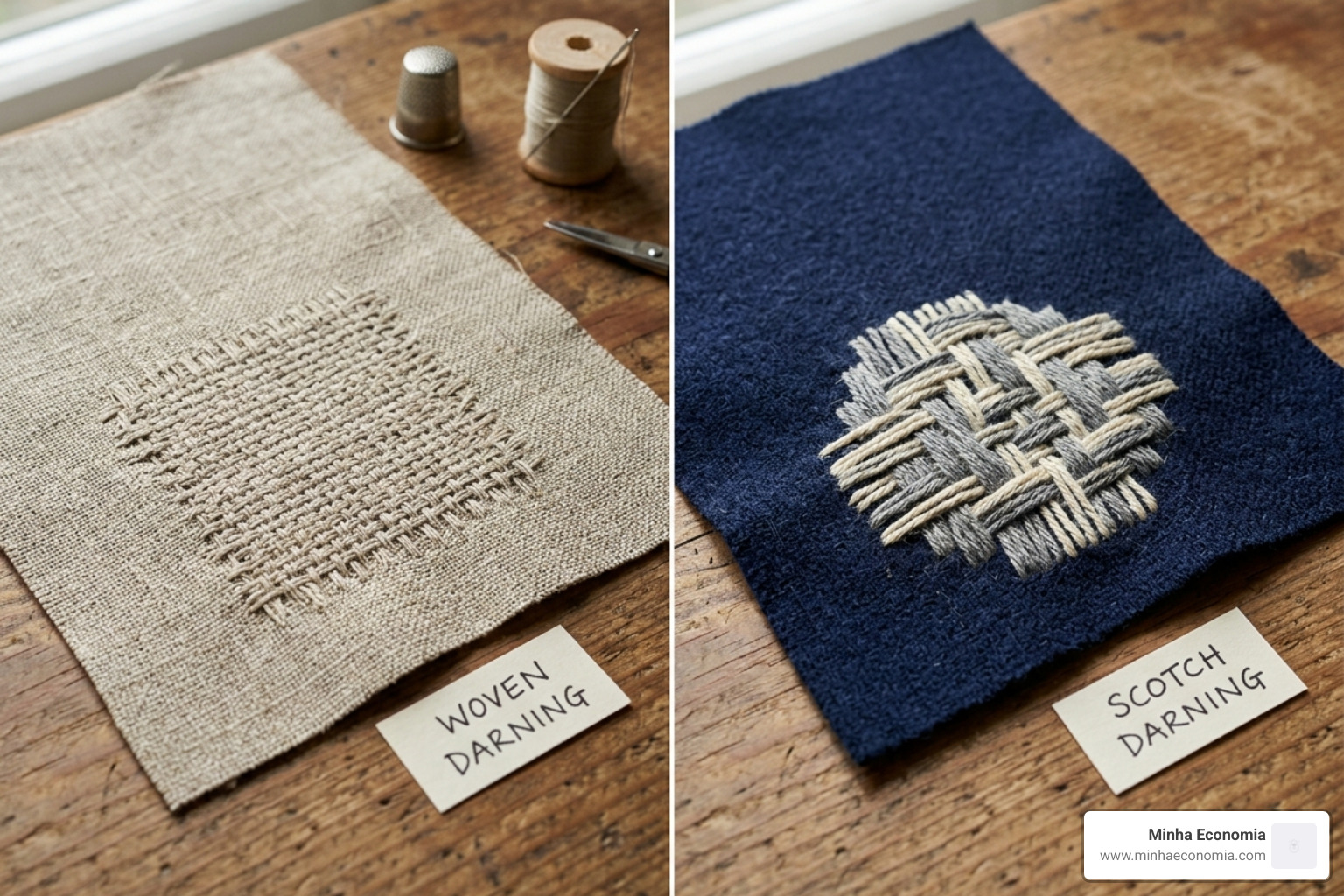
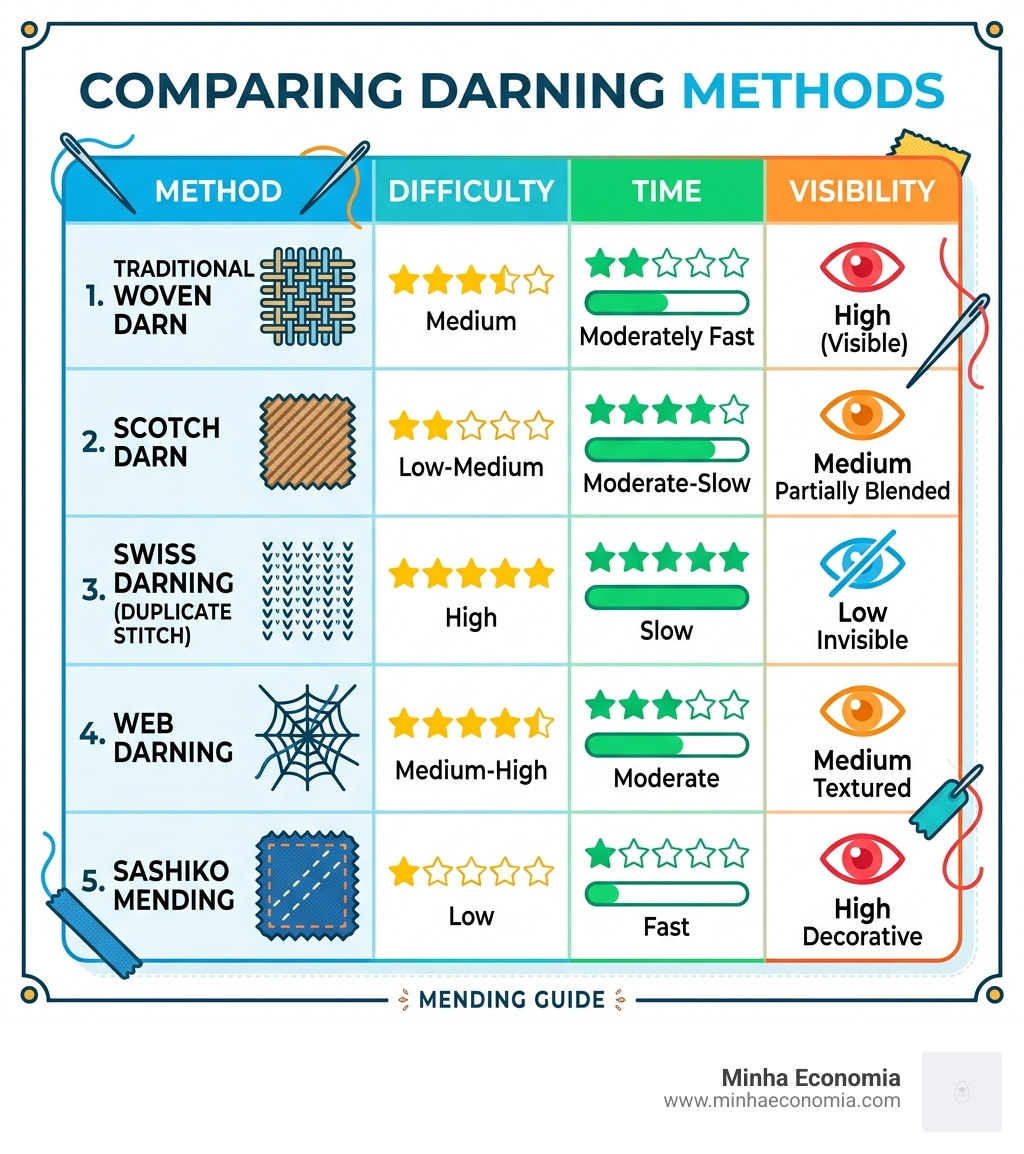
According to historical records and modern mending practices, Darning is essentially a weaving process. You are literally recreating the lost fabric. Below is a breakdown of how these methods stack up.
The Traditional Woven Darning Methods for Beginners
If you are new to mending, start here. This is the most iconic of all darning methods. It involves creating a grid of “warp” (vertical) and “weft” (horizontal) threads.
- Preparation: Start by sewing a running stitch about half an inch (1.3cm) away from the edges of the hole to reinforce the surrounding weak fabric.
- The Warp: Lay down parallel vertical lines across the hole. Don’t pull them tight! Leave a tiny loop at the end of each row so the fabric can move and wash without bunching.
- The Weft: Turn your work 90 degrees. Now, weave your needle over and under the warp threads.
- Finish: On the next row, reverse the pattern (under then over).
This method is perfect for small moth holes and heels of socks. Depending on the size, it takes anywhere from 5 to 60 minutes. It is the ultimate beginner-friendly repair. If you use a contrasting color, it becomes “visible mending,” a popular trend that celebrates the history of the garment. If you match the color perfectly, it becomes a discreet repair that extends the life of your favorite pieces by years.
Scotch Darning Method for Robust Repairs
When you have a high-stress area—like the elbow of a sweater or a large 2-inch hole—the Scotch Darning – How to Mend Knits – 10 Rows a Day Learning Place is our go-to choice.
Unlike the simple weave, Scotch darning uses interconnecting rows of blanket stitch. This creates a much thicker, more durable patch. It begins by creating a “yarn bridge” across the gap and then working the stitches into that bridge.
The result is a rustic look that is incredibly strong. We love using a contrasting color for this method to turn a repair into a “badge of honor” for a well-loved garment. To finish it off neatly, we recommend using an overhand stitch to secure the edges of the patch into the healthy fabric.
Choosing Darning Methods for Knitwear
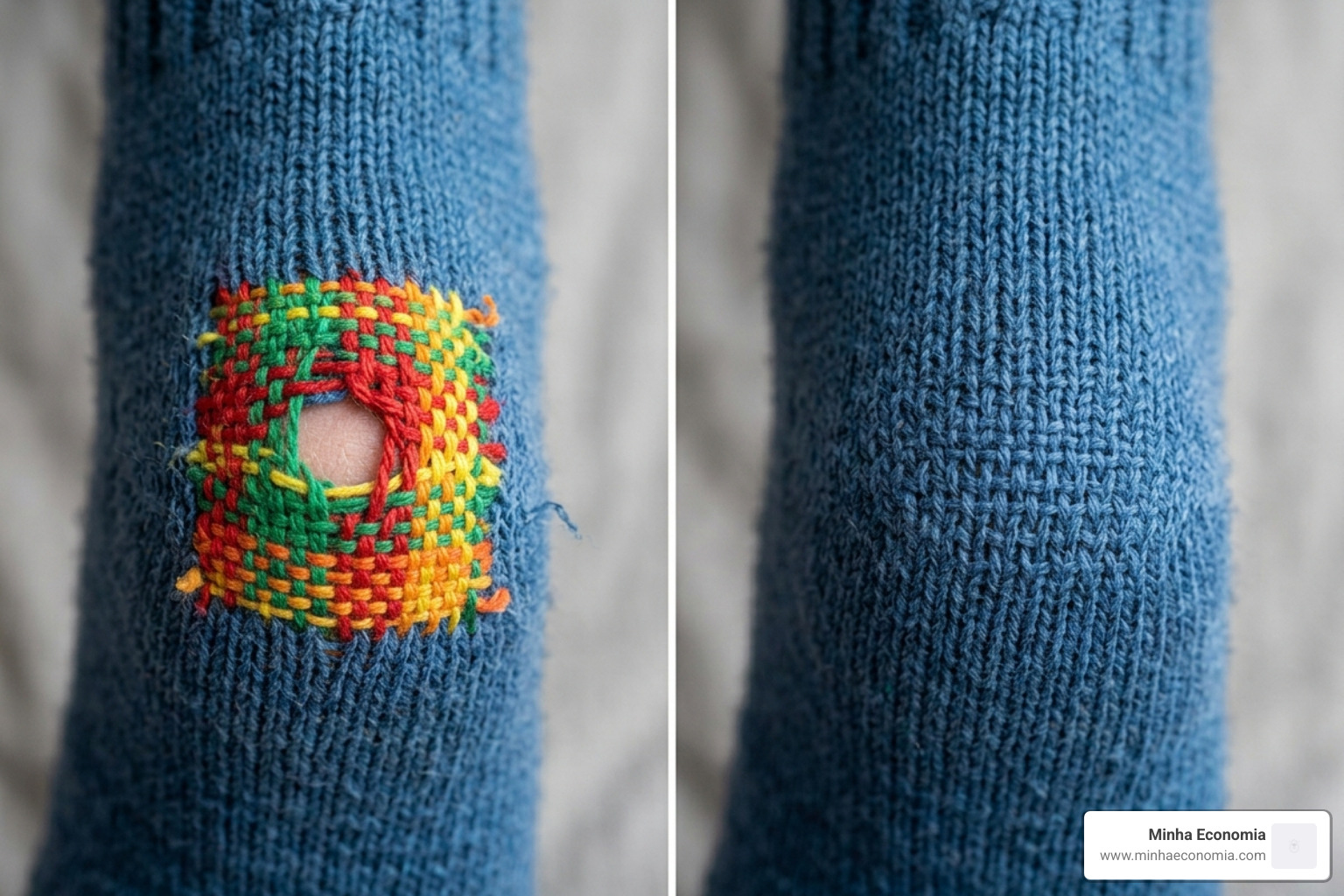
If you are mending a high-quality knit and want the repair to be nearly invisible, you need Swiss Darning (also known as the duplicate stitch).
Swiss darning doesn’t weave a grid; instead, it follows the path of the existing knitted “V” shapes. It literally mimics the knitted structure.
- Pros: It retains the stretch of the original garment, making it perfect for elbows and socks. Because it follows the existing knit, it doesn’t create a hard patch, which is essential for comfort in areas like the underarm where a stiff woven patch might cause chafing.
- Cons: It is an advanced technique and can be quite slow.
If you have a threadbare area that hasn’t become a hole yet, Swiss darning is the best way to reinforce it before the disaster happens. It’s the “gold standard” for textured knits like cable stays or moss stitch.
How to Choose the Right Darning Method for Your Repair
Deciding which of the darning methods to use can feel overwhelming, but we like to use a simple three-step framework to ensure your repair is both functional and aesthetically pleasing:
- What is the fabric type? For natural fabrics like linen or cotton, woven darning is usually best. For wool or wool blends, you can choose between woven, Scotch, or Swiss depending on the item’s thickness. Avoid darning pure synthetics like nylon or polyester if possible, as the repair thread often “cuts” through the plastic fibers over time.
- What is the time commitment? If you’re in a rush to fix a work sock, a quick woven darn or machine darning is your friend. If you’re sitting down for a cozy evening of “slow fashion” repair on a cherished cashmere piece, Swiss darning is worth the effort. Mending is a form of meditation as much as it is a chore.
- Visibility vs. Durability? Do you want the mend to be a secret? Go for invisible darning with a perfect thread match. Do you want the garment to last another ten years? Scotch darning provides the most durability.
Always perform a quick material testing on an inside seam. This is a step many beginners skip, but it’s vital for economic garment care. Check if the repair thread shrinks differently than the garment when washed. If you use a cotton thread on a wool sweater, the first trip through the laundry might cause the mend to pucker and pull, potentially creating new holes around the edges of your hard work! See how the thread sits against the fabric before you commit to the middle of a sleeve.
Frequently Asked Questions about Darning
Is darning difficult for beginners?
Not at all! Darning methods like the traditional woven darn are very forgiving. If your weaving isn’t perfectly straight, the patch will still hold. We recommend starting with a pair of thick wool socks—the larger stitches make it much easier to see what you are doing. As you get comfortable, you can move on to more advanced techniques like Swiss darning.
Can I darn a hole using a sewing machine?
Yes, and it is a lifesaver for large areas! You will need a darning presser foot (sometimes called a quilting or embroidery foot) and a stabilizer underneath the hole. By using a zig-zag stitch and moving the fabric back and forth, you can “thread-paint” over a hole in seconds. This is especially effective for high-wear areas like the inner thighs of denim jeans or large utility sacks. When machine darning, the key is to keep the fabric moving at a steady pace. While it lacks the meditative quality of hand darning, it is the most efficient way to save a pair of work trousers that would otherwise be destined for the bin.
How do I make my darning invisible?
The secret to “disappearing” mends lies in three things:
- Match the thread: Don’t just match the color; match the weight and the fiber (e.g., silk thread for silk fabric).
- Follow the grain: Always align your stitches with the vertical and horizontal threads of the original fabric.
- Take small even stitches: The smaller your stitches where the mend meets the “healthy” fabric, the less the eye will notice the transition. Patience is your best friend here.
Conclusion
At Minha Economia, we believe that economic empowerment starts with the small things—like making sure your favorite clothes don’t end up in a landfill. Learning these darning methods is a form of self-sufficiency that pays dividends. You save money on replacements, reduce your environmental footprint, and gain the satisfaction of working with your hands.
Whether you choose a rustic Scotch darn or a delicate Swiss duplicate stitch, you are participating in a centuries-old tradition of garment care. So, grab that “holey” sock and a needle. It’s time to stop the fray and start mending!
