
Save a Grand Fast with the 1000 Savings Challenge
What Is the 1000 Savings Challenge (and How Does It Work)?
The 1000 savings challenge is a simple, self-directed goal to save exactly $1,000 within a set timeframe — and it’s one of the most popular ways to build your first emergency fund or hit a specific financial target.
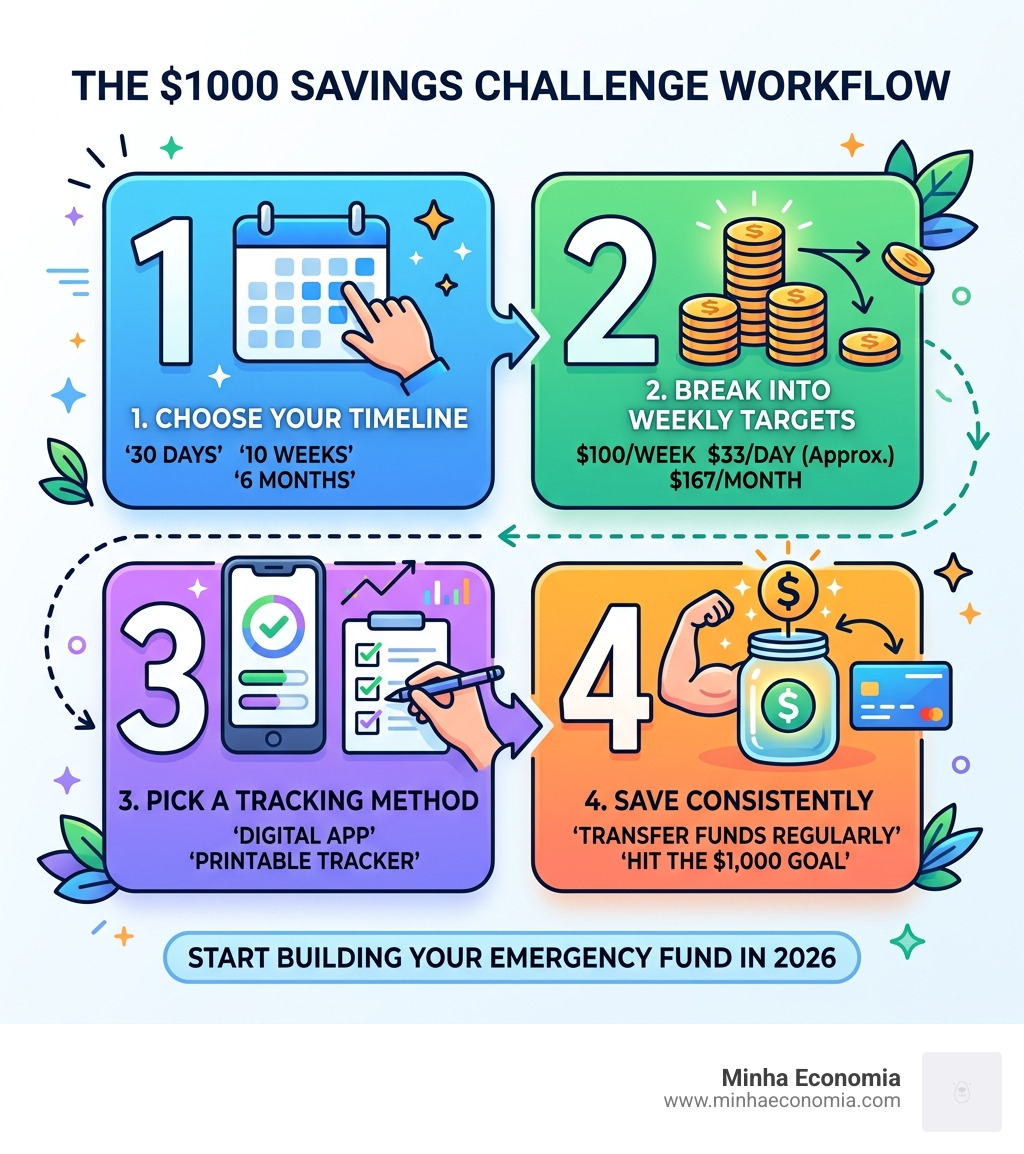
Here’s the quick version:
- Pick a timeline — 30 days, 10 weeks, 15 weeks, or 6 months
- Break it down — $33/day, $100/week, or $167/month
- Choose a method — cash envelopes, printable tracker, digital app, or savings account
- Save consistently — color in your progress, transfer funds, and hit $1,000
No complicated investing. No financial degree required. Just a clear goal and a plan.
If you’ve ever felt like saving money is impossible — especially with rent, groceries, and everyday costs eating into every paycheck — you’re not alone. Most people in their 30s are one unexpected bill away from going into debt.
The good news? You don’t need a big income to save $1,000. You just need a system.
Financial experts consistently recommend having at least $1,000 as a starter emergency fund before tackling bigger goals. It’s the cushion that keeps a car repair or medical co-pay from turning into credit card debt. And a structured savings challenge makes reaching that number feel achievable — even fun.
One personal finance writer shared that it took her and her husband five years to save their first $1,000 because life kept getting in the way — dental bills, a move, a stretch of unemployment. A structured challenge with a clear target and a visual tracker can make a real difference in staying on track when life gets messy.
Why You Should Start a 1000 Savings Challenge Today
Starting a 1000 savings challenge in April 2026 is about more than just the balance in your bank account; it’s about the mental shift from being a “spender” to being a “saver.” We often find that the hardest part of personal finance isn’t the math—it’s the habit.

When we set a specific, time-bound goal, we trigger a psychological response that makes us more likely to succeed. According to Scientific research on the benefits of financial goal setting, having a concrete target helps maintain focus and increases the effort we put into achieving it.
Here is why we believe this challenge is a game-changer:
- Financial Peace of Mind: Knowing you have $1,000 tucked away means you don’t have to panic when the “Check Engine” light comes on. It provides a foundational layer of security.
- Habit Formation: By consistently putting money aside—whether it’s $5 or $50—you are training your brain to prioritize your future self. For more ways to build these habits, check out our saving strategies.
- Debt Prevention: High-interest debt is expensive and snowballs quickly. That $1,000 acts as a shield, preventing you from reaching for a high-interest credit card when life happens.
- Psychological Wins: There is an incredible sense of accomplishment that comes from crossing off that last box on a tracker. These small “micro-wins” build the confidence you need to eventually tackle larger goals, like saving $5,000 or $10,000.
We recommend celebrating your milestones. Did you hit the $250 mark? Treat yourself to a small, low-cost reward, like a favorite coffee or a movie night. This positive reinforcement keeps the momentum going.
Choosing Your Timeline: From 30 Days to 6 Months
One of the best things about the 1000 savings challenge is its flexibility. There is no “one size fits all” approach. Depending on your current income and expenses, you can choose a pace that feels challenging but not impossible.

Here is a breakdown of the most common timelines to help you decide which path is right for you:
| Strategy | Timeline | Daily Target | Weekly Target | Monthly Target |
|---|---|---|---|---|
| Aggressive | 30 Days | ~$33.33 | $250.00 | $1,000.00 |
| Popular | 10 Weeks | ~$14.28 | $100.00 | ~$400.00 |
| Structured | 15 Weeks | ~$9.52 | $66.67 | ~$266.00 |
| Steady | 6 Months | ~$5.50 | $42.00 | $167.00 |
30-Day Aggressive Plan
This is perfect if you have a looming expense or just want to rip the Band-Aid off. It requires saving about $33 to $34 every single day. This usually means a “no-spend month” where you cut all non-essential costs—no eating out, no new clothes, and no entertainment subscriptions for 30 days.
10-Week Popular Plan
This is the “Goldilocks” of challenges—not too fast, not too slow. Saving $100 a week is a significant commitment, but for many, it’s achievable by combining a few expense cuts with a small side hustle.
15-Week Structured Plan
A unique way to approach this is a variable schedule. You might start with $20 in Week 1, peak at $97 in Week 8, and then taper back down. This prevents “savings fatigue.” Alternatively, a flat $67 per week will get you slightly over the $1,000 mark by the end of 15 weeks.
6-Month Steady Plan
If you are on a tight budget, this is the most sustainable route. Saving $167 a month (about $42 a week) allows you to build your fund without feeling like you’re depriving yourself of every joy. It’s a marathon, not a sprint.
Effective Methods to Master the 1000 Savings Challenge
How you save is just as important as how much you save. We’ve seen everything from high-tech apps to old-school jars work. The key is to find the method that keeps you engaged.
- Automated Transfers: This is the “set it and forget it” method. Set up a recurring transfer from your checking account to a separate savings account the day after you get paid. This ensures you “pay yourself first.”
- High-Yield Savings Accounts (HYSA): Don’t let your money sit in a standard checking account earning 0.01% interest. Move it to an HYSA where it can earn a much higher rate. Even if interest rates aren’t sky-high, every penny helps!
- The Round-Up Method: Many modern banking apps offer a feature that rounds up every purchase to the nearest dollar and moves the change to a savings account. It’s passive, painless, and adds up faster than you’d think.
- The Penny Rule: This is a micro-saving strategy where you save “pennies” that turn into dollars. For example, if you pack a lunch and save $7, transfer exactly $7.00 to your challenge fund. Every “found” bit of money—coupons, cash back, or loose change—goes into the pot. Need more ideas? Explore our budgeting resources.
Customizing Your 1000 Savings Challenge Tracker
Visual trackers are incredibly effective because they gamify the process. There are over 600 products on Amazon, like “1000 money challenge” binders and books, that have seen huge sales recently. But you don’t need to buy anything fancy.
A simple printable chart with 100 squares (each representing $10) or a mix of squares ($5, $10, and $20) allows you to color in your progress. This physical act of coloring provides a dopamine hit that keeps you motivated. If you prefer a tactile approach, the 100 Envelope Challenge is a popular variation. While the full version saves over $5,000, you can easily adapt it with 40 envelopes (averaging $25 each) to reach your $1,000 goal.
The 1000 Savings Challenge for Low Incomes
If you are living paycheck to paycheck, saving $1,000 can feel like climbing Mount Everest. However, it is possible through a combination of “micro-saves” and aggressive expense management.
- Audit Your Subscriptions: We often find that people are paying for at least one or two streaming services or apps they don’t use. Canceling a $15/month subscription is an easy $180 saved over a year.
- Bill Negotiation: Use services or simply call your internet and insurance providers to ask for a better rate. Loyalty rarely pays in the service industry; shopping around for insurance quotes every six months is a best practice.
- Sell the “Junk”: Most of us have $200–$500 worth of stuff sitting in our closets or garages. Selling old clothes, electronics, or furniture on local marketplaces can jumpstart your challenge with a few hundred dollars in a single weekend.
- Grocery Hacks: Switching to store brands and planning meals around what’s on sale can save the average household $50 a week. That’s half of your 10-week challenge goal right there!
The Latest research on habit formation and consistency suggests that consistency is more important than the amount. Even if you can only save $5 this week, do it. Keeping the streak alive is what builds the long-term habit.
Staying Motivated and Making Saving Fun
The middle of the challenge is usually where people quit. The initial excitement has worn off, and the finish line still feels far away. Here is how we stay inspired:
- Community Accountability: Join a Facebook group or a subreddit dedicated to savings challenges. Sharing your “wins” and seeing others’ progress provides an external push.
- Ritualize Your Deposits: Make your savings day a “ritual.” Maybe every Friday night after work, you sit down, check your balance, and color in your tracker while listening to your favorite podcast.
- No-Spend Weekends: Turn saving into a game by seeing if you can go 48 hours without spending a single cent. Use what’s in your pantry for meals and find free local events for entertainment.
- Competitive Saving: If you have a partner or a friend with similar goals, make it a friendly competition. Who can hit the $500 mark first? The loser buys the (budget-friendly) celebratory lunch!
- Visual Reminders: Keep your tracker somewhere you see it every day—like on the fridge or as your phone’s lock screen. It serves as a constant reminder of why you are skipping that impulse purchase.

Frequently Asked Questions about Saving $1,000
How long does it take to save $1,000?
It depends entirely on your pace! You can do it aggressively in 30 days ($33/day), popularly in 10 weeks ($100/week), or steadily over 6 months ($167/month). The best timeline is the one you can actually stick to without giving up.
Where is the best place to keep my challenge money?
We strongly recommend a High-Yield Savings Account (HYSA). It keeps the money separate from your spending cash (reducing temptation) and allows it to earn interest. If you prefer a physical method, a locked savings box or a dedicated “savings binder” with envelopes works well, but be mindful of security if you keep large amounts of cash at home.
What should I do after I complete the challenge?
First, celebrate! You’ve done something incredible. Next, look at your financial landscape. If you don’t have a full emergency fund (3–6 months of expenses), keep going! If you do, you might use that $1,000 to pay off a high-interest credit card, start an investment account, or save for a specific “fun” goal like a vacation.
Conclusion
At Minha Economia, we believe that financial empowerment starts with small, actionable steps. The 1000 savings challenge is the perfect entry point into a life of economic independence. It’s not just about the four figures in your bank account; it’s about the confidence you gain knowing that you are in control of your money, rather than your money being in control of you.
Whether you choose to save $1,000 in a month or six months, the most important thing is that you start. Use the tools, print the trackers, and join the thousands of others who are taking their first steps toward long-term wealth.
Ready to take control? Start your savings journey today and see how fast you can reach your first grand!
